Five Things Nobody Tells You About Plastic Packaging Quality (Until It's Too Late)
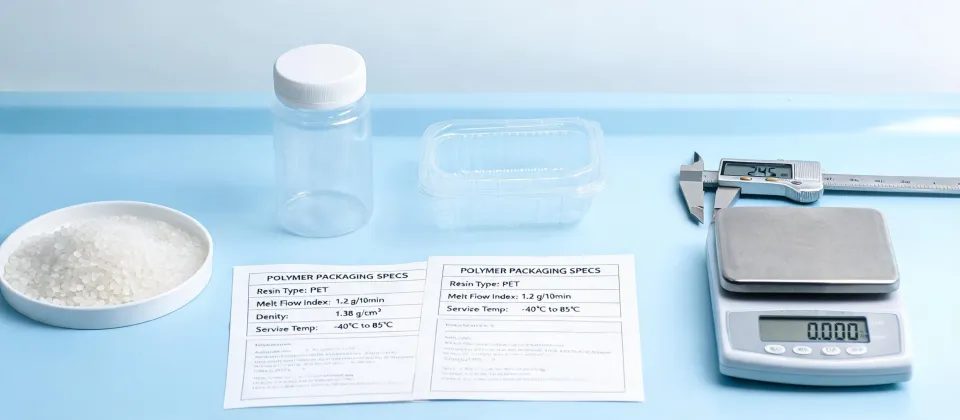
Who This Is For
If you're sourcing clear plastic containers, evaluating resins for injection molding, or fielding questions about "is this BPA free" and "are these bags recyclable" — this checklist is for you. It's a five-step walk-through based on what I actually do when reviewing plastic products before they go to market.
These steps won't make you a polymer chemist. But they will help you avoid the kind of problem that costs you a reprint, a wasted batch, or an awkward conversation with a customer. I've rejected roughly 12% of first deliveries in 2024 alone due to issues that these five checks would have caught.
Step 1: Spec-Walk the Resin, Not Just the Product
Most buyers look at the final product — the clarity of the container, the feel of the lid. Fine. But I start with the resin. If the base material is wrong, nothing downstream can fix it.
Ask the vendor two things:
- What resin grade is this? Not just "polypropylene." Which grade? Different PP grades behave differently under heat, stress, and UV exposure. A general-purpose PP might work for storage bins. It might fail for hot-fill containers.
- What's the melt flow index (MFI)? This tells you how the material flows during processing. If the MFI doesn't match your process (injection vs. extrusion vs. blow molding), you'll get inconsistent wall thickness, warping, or sink marks.
In Q1 2024, we received a batch of 50,000 clear polypropylene containers where the MFI was off by 4 points. The product looked fine out of the mold. After three days in temperature-controlled storage, 8,000 units had developed visible stress lines. The vendor's resin substitution had saved them $0.02 per pound — and cost us a $22,000 redo.
Step 2: Verify BPA Claims — Don't Just Trust the Label
"BPA-free" has become a marketing label as much as a technical specification. The problem is that it's often used sloppily. Some materials are inherently BPA-free (most polyolefins, silicones). Others — certain polycarbonates and epoxy resins — are not.
When a spec sheet says "BPA-free," I ask: how was this verified? Was it by material type declaration, or by third-party testing? For JSP resins, we maintain material declarations from our upstream suppliers and cross-check against known BPA-bearing resin families. But not every vendor does this — and not every vendor is honest.
In 2022, a major retailer had to recall 12,000 units of "BPA-free" containers after independent testing detected trace levels. The manufacturer had been using recycled polycarbonate in their blend without disclosure. Nobody caught it because nobody asked for the testing protocol.
If you're selling into food contact or children's product applications, get the testing methodology in writing. A certificate of analysis from a third-party lab is better than a claim on a landing page.
Step 3: Test the Recyclability Story
"Are plastic bags recyclable?" "Is this container curbside-friendly?" These are the questions that trip up the best marketing copy. Because the answer is almost never a simple yes.
A clear PET container can be recycled in many municipal programs. But "can be" is not "will be." The actual recycling rate depends on:
- Local facility capabilities (is it sorted by polymer type, or single-stream?)
- Color and additives (clear is fine; black or opaque is frequently rejected by optical sorters)
- Residual content (a container that held food needs to be clean — and it often isn't)
Step 4: Calculate the Total Cost — Not Just the Unit Price
This is the one I see trip up procurement teams most often. They compare the per-unit price of Vendor A vs. Vendor B, pick the cheaper one, and wonder why the total bill is higher.
My rule: before accepting any quote, estimate the TCO (total cost of ownership). Include:
- Base price per unit — obvious.
- Tooling or mold costs — sometimes included, sometimes not. Ask upfront.
- Shipping — especially for bulky items like containers. Cheaper per unit + high shipping can neutralize the savings.
- Revision or reject cost — what happens if the first QC pass fails? Who pays for re-run?
- Transaction cost — vetting a new vendor, qualifying materials, managing change orders. This isn't zero.
Step 5: Check the 'Final-Use Fit' — Not Just the Specs
This is the step everyone skips. The resin meets spec. The container looks right. The BPA claim is documented. The cost is within budget. But does it actually work in the end-use environment?
A few years ago, I approved a batch of polyethylene resin for a client making outdoor storage bins. The resin spec was fine for general-purpose molding. But the bins were going to sit on a balcony in Arizona — 120°F surface temp, direct UV exposure. The resin wasn't stabilized for that. After six months, 15% of the bins had cracked.
Simple fix: ask the end-user three questions:
- What temperature will this product see in use?
- Will it be exposed to UV (direct sun, warehouse lighting, retail shelves)?
- Will it contact any chemicals, oils, or solvents?
Common Mistakes
Two errors I see repeatedly:
Accepting "industry standard" as a specification. When I pushed back on an out-of-spec MFI, the vendor said it was "within industry standard." I asked: whose industry? What standard? They couldn't name one. "Industry standard" is often code for "we didn't check." Ask for a written spec, not a shrug.
Testing the sample, not the batch. Samples are often hand-picked, hand-polished, or made with extra care. The first production run is the real test. If possible, request a pre-production sample from the actual production line — not a lab-made prototype.
One more thing: if you're handling regulation-sensitive claims (food contact, medical, children's products), consult current FDA or local authority guidelines. My experience is in industrial plastics and general consumer packaging — your specific application may have requirements I haven't touched. Verify before you commit.