Plastic Resin Selection: A JSP Resins LLC Quality Manager's Guide to Polypropylene, Polyurethane Sheets, and Replacement Parts
If you're looking for a single best plastic resin, I have to stop you early: there isn't one. It depends on how the part is used, how it's processed, what environment it lives in, and what 'better' means for your budget, timeline, and warranty risk.
Before you dismiss that as vague, make a decision with me. I'm a quality and brand compliance manager at JSP Resins LLC. I review roughly 200 resin lots a year—before they go to customers. In 2024, I rejected 7% of first deliveries because the tested properties didn't match the specifications we'd agreed on. That gives me a certain perspective: I care less about which plastic is 'best' and more about making sure the plastic you choose is actually the plastic you receive.
What's your actual use case? Start here
Instead of starting with material options, start with the question the part has to answer.
- Does the part flex, slide, or get rubbed? This is the polyurethane plastic sheet territory.
- Is your question about whether the material is 'green'? This is the polypropylene sustainability question.
- Are you replacing a broken or worn plastic part? This is the aftermarket replacement scenario.
- Are you just trying to move from machined metal to injection molding? Stay with a commodity resin like PP or HDPE.
I know that list feels simple. But the biggest mistakes I see are from people who skip the 'what's this thing actually doing?' question and jump straight to a material datasheet.
Scenario A: You need a part that flexes, absorbs impact, or resists abrasion
If you've ever watched a polyurethane sheet take repeated impacts and keep going, you won't want to go back to a rigid sheet. Polyurethane plastic sheets are not a single material—they range from soft rubber-like durometers (Shore A 60) to hard plastics (Shore D 70+). For a part that gets rubbed, slammed, or cycled, a mid-range polyurethane can outlast HDPE or polypropylene by a noticeable margin. In a 2023 internal test of conveyor wear strips, we saw roughly 3x longer service life with polyurethane vs. HDPE under abrasive sliding. That's not because HDPE is bad—it's because HDPE handles chemicals at high temperatures better than standard polyurethane.
What most people don't realize is that durometer and recovery matter as much as thickness. A 1/8-inch sheet with a Shore 90A hardness behaves completely differently from a 95A sheet. Ask for the material's abrasion loss (DIN abrasion), tear strength, and compression set—not just 'polyurethane.'
Also, if you're buying sheets, shipping can be a hidden line item. In 2024 I saw a quote where freight was almost 40% of the total for a 4x8-foot sheet. The polyurethane itself was competitively priced, but the configuration made the cost look alarming. Get a delivered price, not a per-square-foot price.
That said, polyurethane isn't the answer for every flexibility problem. Standard polyester urethane can hydrolyze over time in hot, humid environments; polyether urethane resists that better. And if you need long-term outdoor exposure plus high stiffness, you might be better off with a UV-stabilized polycarbonate or acrylic, not a flexible sheet.
Scenario B: 'Is polypropylene plastic sustainable?' is the wrong question—mostly
I get asked this almost weekly: is polypropylene plastic sustainable? The honest answer is it depends. If a supplier answers with a quick 'yes' or 'no' and doesn't ask how the part is used, be careful.
Polypropylene (PP) is a fossil-based thermoplastic with the resin identification code #5, according to ASTM International's D7611 standard. It's technically recyclable, meaning it can be melted and reprocessed in the right facilities. But being recyclable is not the same as being recycled. According to the U.S. EPA's 2018 materials data, the overall recycling rate for plastics in municipal solid waste was about 8.7%. PP is part of that story.
So is PP sustainable? That depends on the system around it:
- Long-life PP parts—reusable totes, automotive brackets, washing machine components—are often a reasonable choice because a durable, lightweight part can save energy relative to a heavier or more brittle alternative.
- Single-use PP packaging—if it's not collected and recycled consistently, it's a one-way trip to landfill or incineration. That's hard to call sustainable.
- Recycled PP (rPP)—great in theory, but in practice rPP can vary. I've tested rPP pellets where the melt flow index changed by 20-30% between lots. If you're molding thin-wall parts, that variation will change your fill time, sink marks, and scrap rate.
Here's something vendors won't tell you: don't equate 'bio-based' with sustainable. A bio-based bottle made from corn is still a problem if it's used once and never composted. Meanwhile, a durable polypropylene crate that gets reused 100 times can have a lower environmental footprint per trip than a single-use 'green' container.
If you're using polypropylene, the most practical sustainability moves are: use recycled content where the application allows it, design for disassembly, and confirm that the recyclate is consistent enough for your process. That last one is a quality issue, not just a marketing issue.
Scenario C: You're replacing a failed plastic part
Maybe you have an old part—a fan blade, a valve cover, a conveyor component—and you want a replacement. The first instinct is to say, 'it was plastic, so any plastic should work.' That instinct can be expensive.
In 2022, we had a customer replace a cracked ABS cover with HDPE because it was cheaper and 'felt more durable.' The HDPE part couldn't hold its shape under the same heat load, and the unit stopped working after a day. The lesson: a material isn't a better replacement just because it's tougher in one test. You need to match the entire requirement set—heat, impact, UV, chemical exposure, stiffness.
When you're looking at a replacement, ask for a specification review before ordering:
- What polymer family is the original? Many OEM parts are made with filled PP, not virgin homopolymer.
- What process was used? If it was injection molded, a machined-from-sheet replacement may need thicker walls to stand up.
- What additives are required? UV stabilizers, flame retardants, or glass fillers can completely change performance.
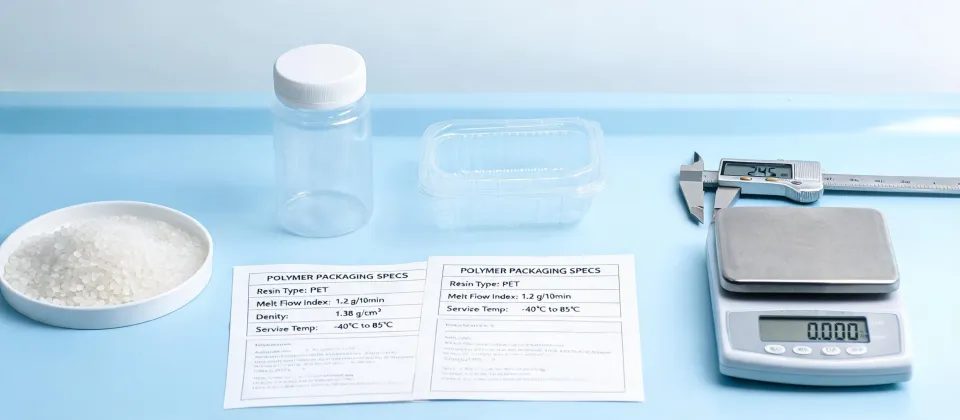
At JSP Resins LLC, we often see mismatches where someone ordered 'polypropylene' without specifying whether it's homopolymer, copolymer, or a glass-filled blend. Those are all PP, but they behave differently in the same mold. At minimum, ask for a material test certificate showing melt flow, density, and Izod impact.
What most people don't realize is that the same grade name from different resin suppliers is not always the same material. One supplier's 'general purpose PP' can process at a slightly different temperature than another's. I learned that the hard way in a 2021 audit where we assumed a supplier's MFI was the same as our standard. It wasn't.
How to find out which scenario you're in
Use three diagnostic questions:
- What is the primary failure mode you're trying to avoid—abrasion or impact, heat, chemicals, UV, or cost?
- How long should the part last? This tells you whether a durable commodity resin like PP makes sense, or whether it's worth spending more on polyurethane or a specialty compound.
- What data do you have about the existing part? If it's an aftermarket replacement, start with a material ID test (density, FTIR, and melt flow) before assuming anything.
One more practical step: put the spec on the purchase order. If you only write 'polypropylene' on the PO, you're giving the supplier permission to send whatever is convenient. Add melt flow, density, impact, and recycled content limits. That small change will save you more headaches than any material selection article can.
If you're still not sure, call a supplier and ask: 'What would you specify if this part had to survive [years] of [conditions]?' A good supplier should ask you questions too. If they don't, that's a warning sign.
And one final thought from someone who has rejected more than a few shipments: I'd rather spend 10 minutes explaining material differences up front than deal with mismatched expectations later. An informed customer makes faster decisions and, in the long run, pays less for revision and rework. That's not a sales pitch—it's just the quality manager in me talking.