Lowest Price Plastic Parts Are Usually the Most Expensive: A JSP Emergency Order Veteran's TCO View
-
Total cost has more columns than the purchase order
-
What does ABS stand for plastic? That question is more expensive than it looks
-
PTFE plastic shows why the material details decide the total cost
-
Mold programs change the math
-
What about purchasing rules that force the lowest bid?
-
Acknowledge the real limitation
Lowest unit price on the screen does not mean lowest cost in the plant. I know that sounds like a generic training slide. I've watched it play out enough to say it as bluntly as I can. In eleven years at JSP, I have helped triage more than 250 emergency orders for industrial plastic parts—a single PTFE plastic bushing, a short polyurethane molding run, an ABS guard that cracked after installation. The most expensive failures almost never came from overpaying. They came from assuming a cheaper quote meant the same spec, the same risk, and the same result.
I have a simple rule now: before I compare prices, I compare consequences. A quote is not a cost. A quote is the first line of a cost story.
Total cost has more columns than the purchase order
One order I still remember came in at 4:30 p.m. on a Thursday. A customer needed a polyurethane drive wheel in 72 hours, or a packaging line would stay down over the weekend. The OEM quoted $980 and six days. A local shop offered to machine one from stock for $340. We quoted $680 because we had an existing jsp mold that could cast the 93 Shore A wheel with a material certificate.
The customer bought the $340 wheel. I don't blame them. On paper, $340 is less than $680. But the local quote did not specify a durometer, a polyurethane formulation, or any test data. The wheel failed a few weeks later. The cost was not the wheel. The cost was the second line stop, the after-hours service call, the lost output, and the overtime labor. If they had asked me to purchase that wheel again, I would still have said: buy the one with the requirements, not the one with the lowest number.
The calculation I use with buyers looks like this:
Total cost = quoted part price + tooling and setup + freight and expediting + installation time + cost of downtime + probability of failure × cost of failure.
Some of those numbers are hard to estimate. But ignoring the hard numbers does not make them disappear. It just makes them show up later with a larger invoice attached.
What does ABS stand for plastic? That question is more expensive than it looks
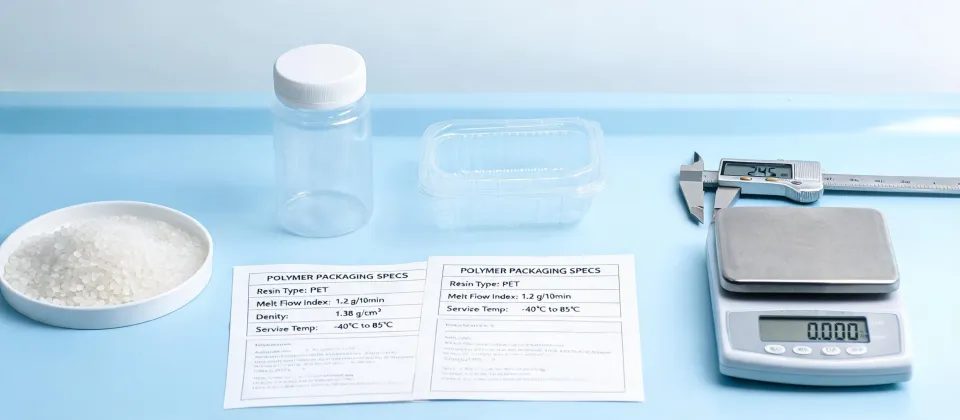
People search “what does ABS stand for plastic,” and the usual answer is acrylonitrile butadiene styrene. That is correct—but it is also incomplete. ABS is a plastic family, not a single formula. There are high-impact ABS grades, fire-retardant grades, extrusion grades, injection molding grades, and grades designed for chrome plating. They are not interchangeable.
If someone quotes a lower price for “ABS” without saying which grade or which test standard, they are not really giving you a quote. They are giving you a label. Ask for the datasheet. Ask for impact data. Ask what test method the supplier used. According to ASTM International, D638 is the standard tensile test for plastics, and D256 is the standard Izod impact test. If a vendor cannot answer those questions, the material spec is not the same—even if the material name is.
PTFE plastic shows why the material details decide the total cost
PTFE plastic is another trap. PTFE is famous for chemical resistance and low friction, but unfilled PTFE can wear or deform under load in some bearing applications. Filled compounds—PTFE with glass, carbon, or bronze—are often used when the part has to survive continuous movement and pressure.
A lower-priced unfilled PTFE plastic bushing can look and feel nearly identical to a filled one. In a static seal, it might be fine. In a rotating application, it might fail quickly. The filled bushing costs more per part, but if it lasts years longer and keeps the line running, it is cheaper per day. I still kick myself for not forcing this conversation earlier in my career. We ordered an “equivalent” PTFE plastic bearing from a low-priced vendor in 2022, and it wore out before the maintenance interval. The replacement cost more than the bearing—it cost us credibility with the plant manager.
The moral is not to always buy filled PTFE. The moral is to buy the PTFE compound that actually matches the operating condition. That is a technical decision before it is a price decision.
Mold programs change the math
Here is where the word jsp mold comes in. At JSP, a quote that references the jsp mold program often means the tooling has already been proven. Someone has already run the part, measured it, and confirmed the production process. That history has value because it lowers the probability of sampling surprises, rework, or another engineering cycle.
When you use the jsp store and order a part that has existing production history, you are buying more than plastic. You are buying traceability to a material grade and a dimensional validation record. A new shop with an attractive first-article price may be starting from nothing. They might need three mold trials before the part prints right. Those trial costs rarely appear on the initial quote. They appear later, hidden in delays and engineering hours.
I am not saying new suppliers are always bad. Some of the best custom plastic work I have seen came from a shop that had never made the part before. But in those cases, the buyer made a decision based on technical capability, not just price. If a quote is lower because it leaves out mold qualification, material testing, or failure risk, it is not a cheaper quote. It is an incomplete one.
What about purchasing rules that force the lowest bid?
I hear that objection a lot: “Our purchasing policy requires the lowest responsive quote.” Fine. Then make your specification so tight that the lowest responsive quote has to include the information you need.
Your RFQ should list the material grade, the required durometer or tensile strength, the test methods, the maximum lead time, the mold qualification procedure, and the acceptable tolerance. If a vendor cannot confirm those requirements in writing, their bid is not responsive. If they can confirm them and still come in lower, use them. That is exactly how total cost thinking should work.
If you skip the requirements because you only want the lowest purchase price, do not be surprised when the vendor meets your expectation. You asked for a low price. They gave you one. The failure later belongs to the spec, not just the vendor.
Acknowledge the real limitation
My experience is based largely on medium-volume industrial replacement parts—custom molded components, engineering plastics, and short-run polyurethane molding work. If you are buying railcars of virgin commodity resin and reprocessing it through an extruder, total cost includes a different set of variables, such as material storage, moisture control, and scrap reclaim. I cannot tell you that all of my rules transfer perfectly to that world.
But for a replacement part that stops a line when it fails, the total-cost view is not optional. The most frustrating part is that the real cost of a bad purchase never appears in the purchasing system. Nobody opens a PO for lost production, overtime, or the second shutdown. The buyer looks good because the unit price was low. The plant pays the rest.
So here is my position after years of emergency orders: do not choose plastic parts by price. Choose them by risk, then by cost of failure, then by total cost of ownership. If the cheap part is truly the same material, same mold history, same tolerances, and same delivery risk, buy the cheap part. But if you are saving $340 on the front end and exposing the plant to a $20,000 downtime event on the back end, you are not making a sound purchasing decision. You are placing a bet with someone else's production line.
Price is what you pay. Total cost is what you keep paying. Check the second number before you approve the first.